_________________________________________________________________________________

Please call 801-870-2070 to order

Tuesday, August 7, 2012

Tax Cut Extensions - Guest Post


**This is a guest post.  
The views expressed in this post are not necessarily shared by Chris Heimerdinger**


With all of the talk about “extending Bush era Tax cuts” and whether they should be extended and to whom, I thought I would pop in and tell you my thoughts.  I know that not everyone has the time to read or watch the news or the desire to read the same kinds of books I do, so hopefully I can help explain what is going on.  I will be as short and succinct as possible (I know you ladies and gents, unlike myself, lead interesting lives ;)
Hopefully my tax accountant family members will chime in if I get something wrong.
First of all I feel that I should define a few words that are often thrown around in elections years.
GDP or Gross Domestic Product – This is the total value of goods and services provided in a country in one year.  In ordinary speak: the total value of all of our exports, all sales of goods, all sales of services and basically all money earned for everyone in the US combined.  What I do NOT know is if it only entails goods and services, or if this also includes investment income (401k, IRA’s etc.)
U.S. Debt – The amount we owe to other countries, people or to our own citizens in the form of treasury bonds.  In ordinary speak: the total amount the U.S. has borrowed including interest.  Think of adding your mortgage, students loans, car loans, credit cards, other personal loans you may have, etc together.  As of this writing, the U.S. Debt is about $15,895,000,000,000.  You can see what it is nowhere.
Deficit – The amount we are short when we subtract our expenses from our income.  Think of balancing your budget or checkbook and if you are in the red at the end of the month, you have a deficit.
Ok.  Now that we have our vocab lesson out of the way we can get into the fun stuff.  I’m sure you have heard on the news how there are two different tax bills floating around there.
  1. Extend the “Bush Era” tax cuts to everyone (this is the one the House of Representatives likes)
  2. Extend the “Bush Era” tax cuts to everyone making under $250k for married filing jointly and let them expire for everyone else (this is the one the Senate likes).
I think my explanation so far has been unbiased and correct (to my knowledge).
Now I depart from unbiased and move completely into my opinion.  Feel free to disregard it or adopt it as your own.  Obviously I would prefer you share my opinion, because I’m right :)
Lets get one thing straight.  These tax cuts started in 2001.  After 11 years, I think it is foolish to continue to call them “tax cuts”. They were tax cuts at the time, but they have been extended for so long that they are now the status quo.  This tax system is all that anyone who entered the work force since 2001 has ever known, including myself and most people that I graduated high school with.  That is the reality, so I will no longer be referring to this argument as whether or not we should be “extending tax cuts” but  whether or not we should “raise taxes” on families making $250K or more.
It should come as no surprise to you, especially considering my fondness for Milton Freidman, that I am in agreement with the House in that we should not raise taxes on anyone.  As good old Milt said, ““I am in favor of cutting taxes under any circumstances and for any excuse, for any reason, whenever possible.”  I feel that way because I think that I can do better things with my money than the government can.  For every dollar that I send to Washington, the federal government wastes half of it in regulations, unnecessary bureaucracy and pork.  I would rather give one whole dollar directly to a hungry person, than let the government pocket half of it and then divide what is left between infrastructure, military spending, social security and all of the programs that are supposedly there to help feed the hungry.
I should clarify something before some of my friends and family have a conniption.  I am not an anarchist.  I do believe in the federal government and I do believe they have a roll to fill and that yes, they do need tax dollars to run.  I do not believe that every pie the Federal Government currently has it’s fingers in is a necessary pie.  There are those that think that because I am not for nationalization of something, means that I am against the thing itself.  This couldn’t be further from the truth.  I just believe that the thing can be done better, more effectively, more efficiently and more cost effectively by either the state, town or person.
For example if I were president, the first thing I would get rid of is the Department of Education.  Some would assume that means I am a barbarian who think people shouldn’t learn.  It would surprise them to know that I spend more hours a day educating myself and my children then most people do while at their full time job.  They would be surprised to know that I think that education is one of the most important things people can do to better themselves and expand their sphere of influence.  A few years ago, the average cost per student in my state was nearly $13,000 per year, with a peak of $24,000 in one city.  The per student cost in my home is a tiny fraction of that (and I am including myself as a student which includes my ever growing history/political book addiction and Matt with all of his $400 medical books). Granted I don’t have a salary, and I double as the cafeteria lady and the janitor, but nor do I have union dues to pay and union regs to deal with.
I also believe that you can’t force someone to learn, but it’s something you have to hunger for yourself.  Education is not a “one size fits all” program that can be dictated from Washington. No matter how much money is thrown at it, our children will not succeed unless we stop micromanaging everything that they do and allow them to be themselves.  It is no coincidence that our graduation rates drop every time Washington gets it’s dirty little fingers into our education requirements.  Our country once led the world in primary education, but history has shown that the US Dept. of Education is one of the worst things this country has done to teachers and students.
That is just one example.  I could give you many more.  All you need to do is ask :)
There is another reason why I am against raising taxes at all.  I’m sure you have heard something along the lines of “the rich will get tax cuts on the backs of the poor and middle class” or “the poor and middle class will have to pay for the tax cuts for the rich”.  These talking points are nothing more than blatant lies.
If you get up every morning and go to work, the paycheck you get at the end of the week is the money you have earned with a healthy chunk of it confiscated for taxes (like state, federal, FICA and Mediwhatever).  You worked, you got paid.  If your tax rate is lowered you get to take more of that money home to use how you see fit.  If your taxes are raised you have less of it to use.  It really is that simple.
Lets pretend that my tax rate goes up but your tax rate goes down.  I have more money go to Washington and less in my pocket to buy groceries.  You have less go to Washington and more in your pocket.  My money did not go into your pocket.  It went to Washington.  Therefore, I did not pay for your tax cut even though I have less money in my pocket and you have more.  You were just allowed to keep more of your own money that you earned and I was allowed to keep less of mine.
But it’s even worse than that.  The talking heads keep talking about how ”the poor and middle class will have to pay for the tax cuts for the rich”.  They are, in essence saying that if everyone pays the same thing they have been paying for the last ten years, then, somehow the poor and middle class are paying more… even though they are paying the same.
It comes down to a basic ideological difference between the Big Government politicians and myself.  I believe that I earn my money.  It is not given to me by the government.  I provide a service or product directly to another person and they pay me for it.  If, for some reason we lived in a communist nation where everyone got the same paycheck directly from the government no matter what job they had or how long they worked for or whether they worked at all, then maybe we could say that our money comes from the Government.  But it doesn’t.  The government doesn’t create or make anything, it “makes” it’s money by confiscating it from someone who did make something.  The government cannot pay for something without having first taken that money from someone else who, chances are, will not benefit from what the government wants to do with that money.
Before any of you scream “but you are in the military, you ARE paid by the government!” Yes, you are right.  We are in the military and we are paid by your federal tax dollars.  We also provide a valuable service in exchange for that payment and we also pay taxes on that paycheck, so in a sick sort of way we are helping to pay our own salary.  Even within the military we do not all get paid the same.  Matt has a select set of skills and knowledge that are hard to come by in the Military, so he is paid more than someone with a job that anyone can be trained to do.  While both jobs are important, one is more easily replaceable than the other.  That is supply and demand.  Even someone who starts out at the bottom can acquire skills and knowledge that make him/her less replaceable, and as such, their compensation goes up.  That is how it works.  The more you know and the more you can do, the more valuable you are, even in the military.
I cannot say the same for all government programs.  Throw unions into the mix and it’s even worse.  But that is a post for another day ;)
Tax avoiders are not the same as tax evaders.  Our tax code is 73,608 pages long.  (That’s about 26.5 feet tall) Those pages are full of rules and regulations and what some people call “loopholes”.  I don’t call them “loopholes” I call them tax deductions.  Honestly, when was the last time one of us said, “You know, I don’t think I’ll take the mortgage deduction or the charitable donation deduction.  I don’t want to take advantage of these unfair loopholes.”  Um… never.  Even these holier than thou Hollywood elites who are clamoring “for the rich to pay their fair share” hire really smart tax guys so that they can pay as little tax as legally possible.  In fact, many of them, while they live in California, have legal residency in a state that has no state income tax.  So what they are really saying is that everyone else should pay their fair share, because they are paying more than enough.  Kind of like how Warren Buffet is saying the rich should pay more while at the same time suing the IRS to get the $1 billion he owes in back taxes lowered.  That is what the rest of the world would call “hypocritical”.
The reality of the situation is that most of these big bad corporate businesses and rich guys aren’t cheating on their taxes.  They are taking legitimate tax deductions so that they can lower their tax burden, which can come to more than 50% depending on the state they live in (**cough** California).  So next time you hear the words “tax loopholes” just replace the word loophole with deduction and it will shine a whole new light on the situation.  When you hear politicians talk about “closing loopholes” remember what that means for you and your wallet.  I’m all for a simpler tax code, but I would get there by starting from scratch, rather than adding onto the monstrosity that we currently have.
No one clamoring for tax hikes thinks that it will be more than a tiny drop in the ocean of debt and deficit that we currently have.  It is entirely about “making the rich pay their fair share”.  They are far more concerned about punishing those who make a lot of money then they are about getting our Federal Government’s fiscal house in order.  So what I want to know, is how people who make 250k somehow make it into the “millionaire and billionaire” category.  Last time I checked, 250k was a farcry from 1 million.  You know already that I am not in favor of a progressive income tax in any way shape or form, but it is honestly not a deal breaker for me.  But punishing productive and hard working small business owners (and therefore their employees) is far more “unfair” than than anything that I might suggest.  For 2009 the tax breakdown was as follows
Percentiles Ranked by AGI
AGI Threshold on Percentiles
Percentage of Federal Personal Income Tax Paid
Top 1%
$343,927
36.73
Top 5%
$154,643
58.66
Top 10%
$112,124
70.47
Top 25%
$66,193
87.30
Top 50%
$32,396
97.75
Bottom 50%
<$32,396
2.25
Note: AGI is Adjusted Gross Income
Source: Internal Revenue Service
How is this at all fair?  The top 10% of earners in our country paid more than 70% of our country’s taxes and the bottom 50% paid almost none?  I understand that it is less of a burden for a millionaire to pay taxes than someone who makes 20k.  I also know that the person who makes 20k qualifies for several governmental welfare programs (even more today than 2009) and so they don’t really feel that pinch do they?  Nor do they have any sense of ownership in the country they are benefiting from.  In essence “they didn’t build that”, did they?  Yet they are enjoying all of the perks and more than those of us who do pay taxes.  All they have to do is get the average income low enough so that 51% of the population are on welfare, then have them continually vote for bigger and bigger welfare checks!  That, my friends, is what some of us would call “taxation without representation”.  I seem to remember a war that was fought over that principle.
Lets get one thing straight.  The current tax code is not fair at all, because the “millionaires and billionaires” (and apparently that means everyone making above $250k a year) are carrying nearly allof the burden, not because they aren’t carrying enough of it.
This brings us to the final clarification I would like to make about the current “to raise or not to raise” debate.  Another phrase you will hear thrown around a lot is “Clinton Era”.  A lot of people are saying they just want to get back to “Clinton Era” tax rates.  People remember the 90′s as a very prosperous time, and it was.  We cannot, however, get ourselves back in to the prosperity of the 90′s by having “Clinton Era” tax rates alone.  I would be supportive of “Clinton Era” tax rates if we first got back to “Clinton Era” regulations, “Clinton Era” spending levels (including entitlement spending), ”Clinton Era” GDP, ”Clinton Era” GDP to spending ratio, ”Clinton Era” foreign relations (aka not being in five wars), had “Clinton Era” deficits (aka none for half of the time he was in office) and for good measure, we should probably have someone invent something that will absolutely change the world as fundamentally and completely as the Internet did.
Raising taxes cannot possibly have a positive effect on the economy unless and until we attack the regulations with a chainsaw, fix entitlements, get out of these wars; and for heavens sake, stop increasing the spending!  Unless and until that happens, raising taxes should be the last thing on anyone’s mind.
A big Thank You again to Chris for letting me post on his sounding board!

Saturday, July 21, 2012

Photos, Facebook, and New Fanpage

Greetings Tennis Shoes Fans!

Chris Heimrdinger in July 1978 with
Kodak Ektasound Super 8 Movie Camera
I've had my nose to the grindstone writing. Felt it was finally time to come up for air. My mom sent me a photo of when I was an aspiring filmmaker wayyy back in the summer of 1978. It was the year after Star Wars was released. The biggest films that summer were Grease and Christopher Reeve's Superman. I was very much a wannabe filmmaker and had just finished MY first feature film--a monster movie called Stalking Wind. (I really ought to get that thing on YouTube. Right now it's only in Super 8 and VHS formats.)

I wanted to announce a new Facebook Fanpage developed by Brandon and Alexa Wilcox. Go to This Link. I hope this becomes a fun place for fans to get unique information. Brandon and Alexa have begun to set up a cool "timeline" that I intend to add to or embellish (in my copious spare time). But hey, they've already put up a ton of stuff.

I know folks want updates. The next Tennis Shoes book (Vol. 12), I was pleased to discover, is writing itself. I just peek at it from time to time to see how it's coming. Very exciting so far. But my guess is that we're still looking at summer/fall of 2013. It's like writing War and Peace right now (Hey, that could have a double meaning! Except mine was mostly related to sheer Tolstoy-ian length). As I've always suspected, Thorns of Glory will probably get chopped into two books, but I won't let any part of it get released until the whole thing is complete and turned in to the publisher. That way fans can be assured that if a second part is withheld, it will be released within 3 months (or so) of the first part.

I finished a rewrite of my screenplay for my Christmas novel, A Return to Christmas. My production manager wanted me to trim the budget, so I accommodated...I think. Official fundraising starts soon.

Also, this month, on the 29th of July, Hunter Helaman turns the big "1" year(s?) old! Left is a recent photo. He's not walking yet, but he has definitely "stood" on his own for several incontestible seconds. He also clearly says, "Da-Da." Must be hard for a mother to go through so much intensive labor and work caring for baby that first critical year, and then the first word the kid utters is "Da-Da."

Okay, shameless plug. Gotta try and keep my lights on for another month. I've gotten my hands on several classic books, including my original Tennis Shoes Among the Nephites Board Game. Obviously this is a collector's item, but I found (or assembled) 3 pristine copies/editions. Along with that, here's some other stuff I think are either rare and interesting finds or new releases. Many are the only copies I have in my possession. So when it's gone....you get the picture.
3 Games For Sale on AMAZON!
(Note: 1 New and 2 Collectibles)
    BEARS and PRAYERS           Classic Talk CD!
Classic Book of Mormon
Graphic Art Book by
Don Allred


A MASTER'S
TOUCH

A QUIET HEART
Classic David Glenn Hatch!Rare Novel From
Robert Kirby
Classic Book from
Patricia T. Holland


Older Classic From
Duane S. Crowther
A Dorothy Keddington
Rare Classic!
Great Price on Great
Traci Abramson Novel!


On Mega-Sale For
FrostCave Customers ONLY!

PRELUDE TO
GLORY, VOL. 9
MURDER BY
THE WAY
Last Volume of
Ron Carter's Epic Series
Newest Mystery From
Besty Brannon Green

My best to you and yours on this unique Utah Pioneer Celebration on Tuesday, the 24th!!

Stay close to the Lord,
Chris Heimerdinger

Tuesday, June 26, 2012

Voting Criteria for Latter-day Saints

Sure, the Church is politically neutral and doesn't endorse candidates. But does that mean the prophets have said nothing about who and what to vote for?
 
Guest post by Jelaire Richardson and Nathan Richardson

Imagine if someone asked you what kind of music you like to listen to or purchase, and which kind you avoid. You tell her your favorite genres and list a few of your favorite artists and songs. You also tell her which genres and singers you don't like. When she asks you why you choose the way you do, you tell her, "Well, a big part is because of what the living prophets have taught about music and media."

Your friend gets a disapproving look and says, "The Church maintains strict neutrality on music. It does not endorse or sanction individual bands, or record labels, or genres."

You reply, "Well yeah, I'm not saying they've compiled a list of individual songs or artists that are approved or prohibited. But they've definitely given some specific advice on what to seek out, and warnings on what to watch out for."

"I thought they just gave the general advice that the members should 'choose artists they believe will most nearly carry out their ideas of good music.' Can you give me an example of anything more specific than that?"

"Well, For the Strength of Youth says, 'Do not listen to music that encourages immorality or glorifies violence through its lyrics, beat, or intensity. Do not listen to music that uses vulgar or offensive language or promotes evil practices.' So I'm definitely not going to listen to someone like Marilyn Manson."

“The Church does not micro-manage the members’ decisions on music. It's wrong of you to give people the impression that the Church has official positions on individual musicians. It's going to make people think Mormons are brainwashed.”

"I wasn't saying anything like that. But we do have more than just vague directions. We have guidelines to help us choose wisely, and in some cases those guidelines are fairly specific. What do you base your choices on?"

"Oh, aesthetic qualities. How much it appeals to me. Concepts I learned in my music theory class. Nifty album art. I don't think the Brethren would have advice one way or the other on whether I listened to, say, Marilyn Manson. In fact, I bet I could find general authority quotes that were in favor of his music. Besides, you're never going to find musicians who don't swear. They all do it. And any who don't are probably so sappy or amateurish that they'd be terrible to listen to."

*   *   *

Of course, in this story, the friend is throwing the baby out with the bathwater. While the Church might not have a detailed, specific position on individual people or groups, that doesn't mean they've given no counsel on how to choose music. A wise, faithful Latter-day Saint will search out the prophets' counsel and try to make his own criteria match the Brethren's.

I’ve talked to many Latter-day Saints about who they support for elections, whether presidential, state, or local. Sometimes I'll share statements from the prophets about what principles we should have in mind when voting. I have been surprised that some Latter-day Saints respond kind of like the friend in this story. They discourage the practice of applying the gospel to government and law. They might say, “The Church is politically neutral. It does not endorse candidates or parties or platforms.” That's true, but I've been surprised to hear them misapply those facts and come to conclusions like, “The Church has no position on politics at all. The Brethren have individual opinions, but they have made no official statements on laws or government that we should feel bound to follow.” Conclusions like this are incorrect. While the Church is definitely politically neutral regarding individual people, parties, or platforms, it is not politically neutral on principles of government. In some cases, they have even endorsed or opposed specific bills by name. Modern prophets have given us all kinds of counsel on what criteria to consider when voting and being politically involved. If we are wise, we'll search out the prophets' counsel and try to make our voting criteria match the Brethren's.

The purpose of this article is to share what the prophets have said we should consider when voting. It may or may not change who you vote for, but that's not really my goal. Even if it doesn't change who or what you support, I hope it helps you support them for the right reasons.

Describing your usual approach

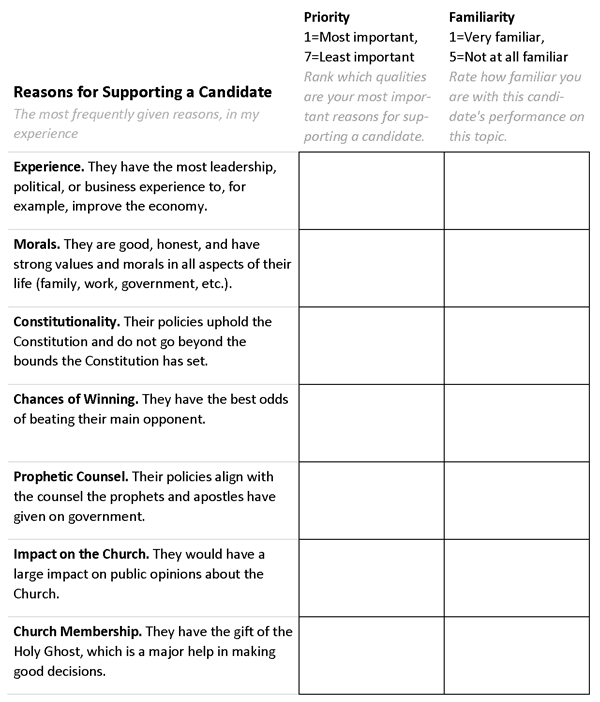
I came up with a little "worksheet" to help learn what the prophets have taught about politics. I listed the reasons I have heard most frequently from Latter-day Saints for why they might support any given candidate. I also tried to read up on what the prophets have said on the subject. I learned a few things I hadn't been aware of before. And even where I had been using the prophets' criteria, I hadn't always been very good about studying the candidates or proposed bills to examine how well they were meeting the criteria.

I invite you to use this chart to examine your thought process in the past. What have you considered when voting for a candidate? Go ahead and get some paper and a pencil (or print this chart out). No, really—go ahead. This exercise will be fun and hopefully helpful by the time you’re done. Read the chart then follow the instructions below it. Rank the Issues. First, in the far left column, rank the most important to least important issues (1 = Most important, 7 = Least important) in the order that you personally have considered when looking at candidates to vote for. You can be honest with yourself. If you find yourself thinking, “Oops, I should have considered that, but I haven’t yet,” then don’t be afraid to honestly reflect that in your ranking. Remember, these rankings are based on what you have considered up until you had read this article. You’ll have a chance to later re-rank things based on if you’ve changed your mind after reading this article.

Rate Your Familiarity. Now that you’ve ranked the qualities that you have considered in the past for candidates, go ahead and rate on a scale of 1 to 5 how well-informed you are on your candidate’s performance in each area (1 = Very informed, 5 = Not informed). You are not rating the candidate’s performance, but rather your knowledge of his performance. For example, I might have ranked Constitutionality as a “1” under the “Priority” column, and my candidate may be perfectly Constitutional, but I may not have studied his voting record close enough to really be sure of that. In that case, I would rate my familiarity with his Constitutionality with a 4 or 5.

What have the Brethren said?

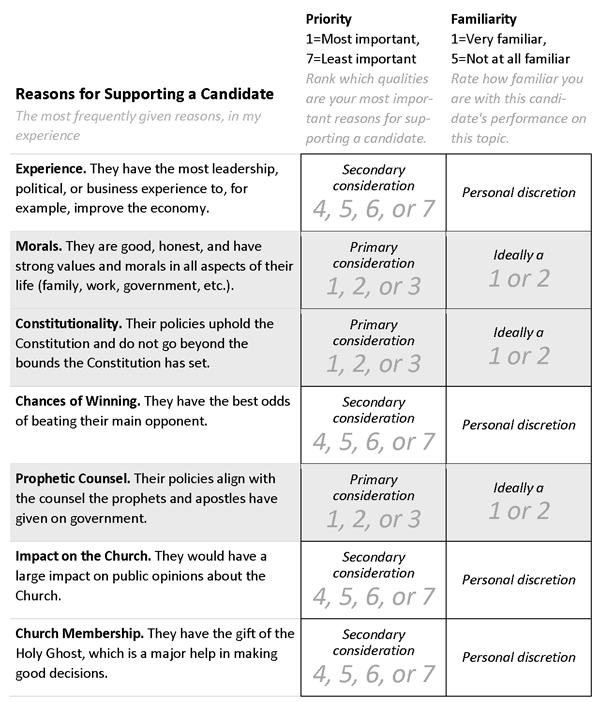
Now that you’ve ranked the issues and rated your knowledge, let’s take a look at what perhaps some of the top-ranked qualities should be if we take to heart what Church leaders have counseled us to consider when we examine candidates and their policies. Check to see how your priority ranking numbers compare. Are your highest ranked ones among the highest ranking ones the Brethren have counseled to consider? Here are three qualities Church leaders have counseled us to look for in a candidate (not necessarily ordered by priority). There may be others, but these are the three criteria that I have encountered repeatedly in my personal study.

A. Morals: Is the candidate honest, good, and wise?

“Members are encouraged to register to vote, to study issues and candidates carefully, and to vote for individuals whom they believe will act with integrity and sound judgment. Latter-day Saints have a special obligation to seek out, vote for, and uphold leaders who are honest, good, and wise (see D&C 98:10).” (Handbook 2: Administering the Church, 21.1.29, “Political and Civic Activity“)
 
“Note the qualities that the Lord demands in those who are to represent us. They must be good, wise, and honest. Some leaders may be honest and good but unwise in legislation they choose to support. Others may possess wisdom but be dishonest and unvirtuous. We must be concerted in our desires and efforts to see men and women represent us who possess all three of these qualities.” (President Ezra Taft Benson, “The Constitution—A Heavenly Banner,” BYU devotional, 16 Sep 1986)
Of course, this immediately raises the question of how to gauge whether someone is “good.” We’re not their bishop, and we’re not the eternal Judge of individuals’ souls. But “while it is true that you should not condemn others or judge them unrighteously, you will need to make judgments of ideas, situations, and people throughout your life. The Lord has given many commandments that you cannot keep without making judgments” (True to the Faith, “Judging Others“), and one of those is the commandment to make at least a basic assessment of a candidate’s morality.

Perhaps one place to start is by listening to character witnesses of friends and business associates who know the candidate well. Exaggeration and spin are common, but if multiple first-hand accounts keep surfacing of a candidate’s right or wrong habits, they might be worth considering. Or you might look at how they keep the most important promises of their lives, such as their wedding vows. When President Gordon B. Hinckley was asked about a politician’s extramarital sex scandal, he said, “The position of the President of the United States of America carries with it a tremendous trust. … George Washington [said] he hoped that ‘the foundations of our national polity will be laid in … private morality … which can … command the respect of the world.’ … Is it asking too much of our public servants … to give moral leadership to the world?” (Larry King interview, aired 8 Sep 1998)

As President Benson noted, not every leader who is honest and good is necessarily wise. How do we know if a candidate is wise? The other two qualities below might answer that question.

B. Prophetic counsel: Is the candidate aligned with positions the Brethren have taken?

“Today I would like to propose … questions which every Latter-day Saint might well ask as he attempts to appraise any program, policy, or idea promoted by any would-be political leader. … I think they will provide a safeguard in electing to office men who will meet the requirements which the Lord has set forth in the revelations. … Is [the program, policy, or idea] right as measured by the counsel of the living oracles of God? It is my conviction, my brethren and sisters, that these living oracles are not only authorized, but are obligated to give counsel to this people on any subject which is vital to the welfare of this people and the upbuilding of the kingdom of God.” (Elder Ezra Taft Benson, “Our Duty as Citizens,” general conference, October 1954)
I’ve frequently heard some Latter-day Saints say, “We shouldn’t use quotes from the Brethren to determine our political choices.” Not only is that untrue, but we are obliged to assess whether candidates and policies measure up to what prophets have advised, according to Elder Benson’s counsel in general conference. Now, it's a different matter to discern the best way to interpret or apply a given prophetic statement to a given political matter. That's certainly up for discussion among Latter-day Saints. But I don’t see how there could be any question as to whether prophetic statements should be among the determining factors. Of course they should. As long as the discussion is civil and informed, we should welcome the insertion of prophetic counsel.

How informed are you on the Brethren’s counsel? (Personally, I’ve frequently fallen dismally short.) Can you, off the top of your head, give specific reasons from the Brethren about why you would or wouldn’t support a given policy? What about words of ancient prophets on principles of government or warfare? I think the best place to start would be general conference talks (for 1971--present, see lds.org; for 1942--1970, go to scriptures.byu.edu and click “General Conference” just under the title). And heck, while we’re trying to immerse ourselves in this, the Brethren have also written much “unofficial” literature on government. Since we often go quoting Gandhi or Mother Teresa about government, shouldn’t we also at least look at the opinions and writings of inspired prophets, seers, and revelators—even when they’re not official stances of the Church? That way, we can use prayer and discernment to help us make our decisions based on the knowledge we’ve acquired by filling our minds with all this great counsel. One helpful source I’ve found it LDSFreedomPortal.net. It is a very thorough list of books, talks, and other material written by prophets and apostles on the topic of government (much of it hyperlinked to read online). This is a great place to start, just to get a feel for what’s out there.

C. Constitutionality: Does the candidate follow the Constitution?

Canonized scripture specifies that the "Constitution ... I have suffered to be established, and should be maintained for the rights and protection of all flesh, according to just and holy principles" (D&C 101:77). There are many, many statements along these same lines by prophets and apostles, so here are just two:
“Next to being one in worshipping God, there is nothing in this world upon which this Church should be more united than in upholding and defending the Constitution of the United States!” (President David O. McKay, general conference, October 1939).
 
“Every Latter-day Saint might well ask as he attempts to appraise any program, policy, or idea promoted by any would-be political leader, … Is it right as measured by the Constitution of this land and the glorious principles embodied in that Constitution? Now that suggests that we must read and study the Constitution, the Declaration of Independence, and the Bill of Rights, that we might know what principles are embodied therein.” (Elder Ezra Taft Benson, “Our Duty as Citizens,” general conference, October 1954).
This is perhaps the most daunting implication of following the Brethren’s counsel, because it means lots of reading, research, and educating oneself. I’ve dragged my feet in the past because it seemed like such an intimidating task with no clear way to start and no end in sight. Also, while the gospel is fairly clear-cut on the basic issues (for example, don't have sex outside of marriage. Period.), when it comes to law and the Constitution, intelligent and sincere people often seem to come to vastly different conclusions.

Still, where the Lord commands, he blesses the smallest initial efforts, which is where I am currently. You can start by reading the Constitution itself. It’s definitely more formal and involved than the average news article, but it’s not really that long. You might consider starting with a simplified Constitution. Others more informed than myself (which means most people) can probably recommend other good places to start your personal Constitutional education.

(Note: this criterion would logically apply mainly when voting about things at the federal level in the United States. State and local candidates should of course abide by state constitutions and municipal charters, but that isn’t as much of a focus of the Brethren, at least from what I’ve read. The federal Constitution seems to carry a unique doctrinal prominence. Of course, it’s also important for state leaders to understand the federal Constitution in order to understand how it bears on their own responsibilities. As for Latter-day Saints in other countries, this counsel may apply less or in different ways, as the Spirit dictates, I suppose.)

What have the Brethren not said?

Interestingly, as I’ve read up on the Brethren’s counsel on what criteria to use when selecting candidates or laws, I have never heard them say we should vote for someone because he or she
  • Has the best leadership or business experience to (for example) turn the economy around
  • Has the best chance of beating another candidate
  • Will have a good impact publicity-wise on the Church worldwide
  • Is a member of the LDS church
I don’t think any of these are necessarily bad reasons (although the Church-membership criterion has the potential of being short-sighted and quasi-Gadianton-like or cronyistic). It’s very desirable to have a leader with experience or influence. But all these reasons should take a back seat to the more important criteria laid out by the Brethren. In other words, the list above should be secondary considerations; our primary considerations should be those which the prophets give: personal morality, wisdom in following prophetic counsel, and wisdom in following the Constitution. Unfortunately, when I’ve heard Latter-day Saints explain why they were voting for a candidate, they frequently don’t mention the primary considerations that the Brethren have given. I would hope that, after encountering the statements above and the many others which could be shown, they would give greater priority to the primary considerations than to the nice-but-not-crucial secondary considerations. From what I can tell, it seems like if the candidates we support do not fit the primary criteria, then the secondary criteria should not be reason enough for us to vote for that person. It seems safe to say that the secondary criteria should not override primary ones.

Re-evaluating your approach

Now that you’ve seen some of the prophetic counsel that we’ve been given regarding selecting candidates and positions, I suggest going back to the ranking chart and seeing if your order of priorities has changed. And if you feel like you have a clearer vision of what the Lord expects of us with civic involvement, I also suggest taking the steps necessary to educate yourself and improve your self-rating of how familiar you are with any given candidate or proposed law. Don’t expect to learn all there is to know overnight, but neither expect that we can put off our informed involvement forever. The First Presidency has been very clear that "Latter-day Saints are under special obligation" to be educated and active at all levels of government.

As a I final thought, I just want to clarify something: While it's important that Latter-day Saints be united on what primary criteria we should use when voting, I've never seen any reason to assume that if we all did, it would mean we would all vote for the same candidates or the same laws, every time. Using the same criteria does not always mean coming to the same conclusions (as with the music example). Good, faithful individual members of the Church can righteously apply prophetic criteria without liking the exact same musicians, but it's pretty certain that discerning people are going to avoid those musicians which clearly violate the most basic standards. Likewise, even apostles come to different conclusions from each other (for example, James E. Faust was a Democrat), but you can bet they agree on the inspired criteria from which they draw their conclusions.

I think the main reason saints will differ is that we apply these criteria differently, or give them different weight, depending on each case. To give a generic scenario, let's say that two Latter-day Saints study Senator Foghorn's personal and career life, as well as his voting record. One Latter-day Saint may conclude that he is basically moral and wise in his decisions, while another might conclude that he is not. Either way, though, they are both using the same criteria, which is what the Lord's representatives are hoping for. In another scenario, let's say two LDS voters agree that Senator Foghorn's morals are iffy, but his voting record is largely aligned with prophetic counsel and Constitutional principles. The first person might decide that the wise leadership decisions outweigh the poor moral ones, and the second person might decide the moral failings are too serious in this case to be ignored. Again, even though they're voting differently, they are both using the same prophetic criteria and thus obeying the Lord's counsel to "study the issues and candidates carefully and prayerfully" in light of the inspired criteria explained above.

What I gather after reading the prophets' words is that the Lord wants us to all agree on what we should be looking for in a candidate or a law, even if we check different boxes in the voting booth. It's only when we dismiss that prophets' criteria that we're on shaky spiritual ground. If we think private morality or Constitutional consistency don't matter in our public servants, or if we are so enamoured of more glamorous characteristics that we habitually excuse failings in the crucial ones, we're in bad shape.


Jelaire Richardson composes piano music on the rare occasion that her children allow it. She also plays racquetball and soccer on the rare occasion that her bum knee allows it. She loves the U.S. women's national soccer team.

Nathan Richardson is creating a custom edition of the scriptures and is excited that at least two non-LDS friends have started reading the Book of Mormon because they liked the new layout. His wife is teaching him racquetball, and he is teaching her patience.